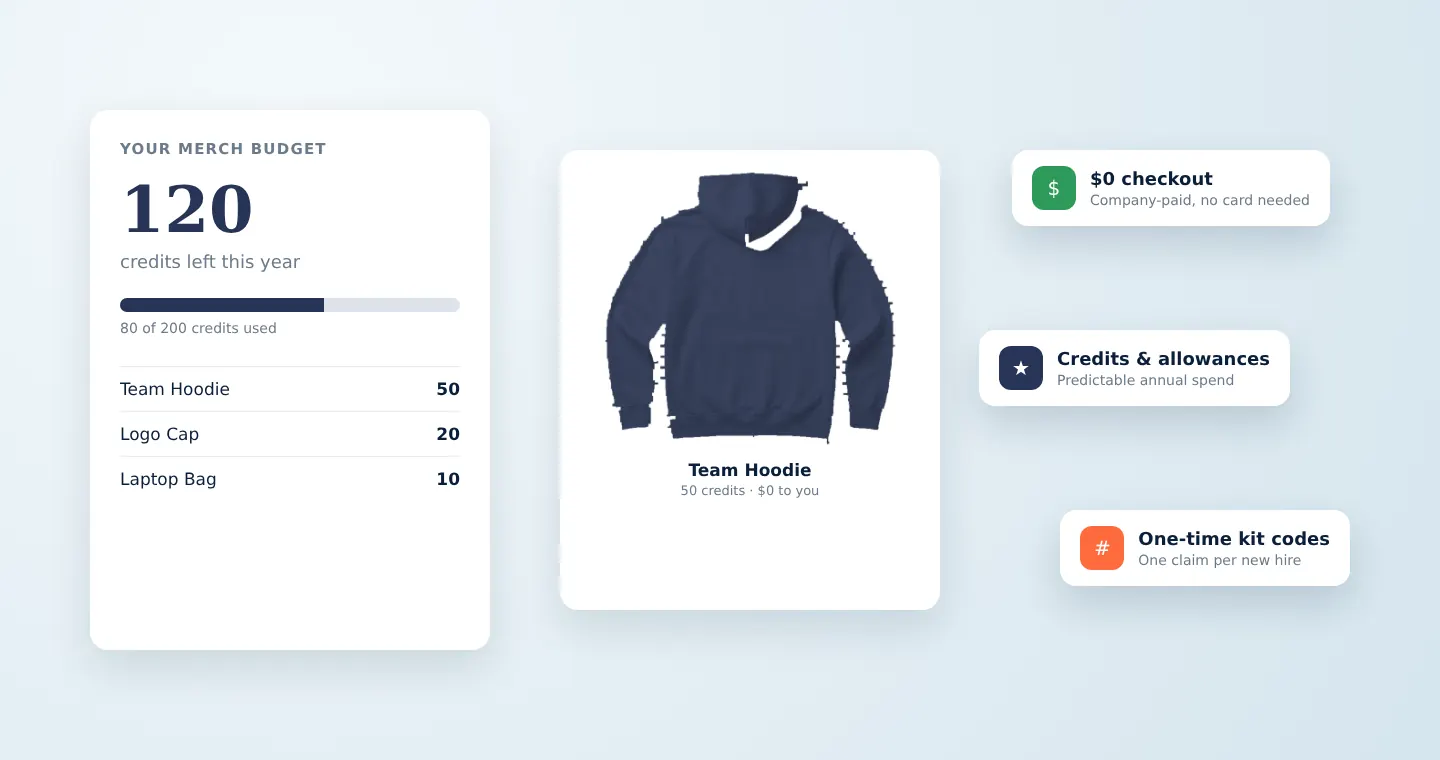
The way employees pay — or don't — decides whether a company store gets used. Get it right and the store becomes a perk people talk about. Get it wrong and it becomes another tool nobody opens. This guide compares the main budget models side by side so People Ops and Finance can agree on one before launch.
The four common budget models
| Model | What the employee sees | Cost control | Adoption |
|---|---|---|---|
| $0 checkout (company-paid) | Every item is free; no card needed | Set by catalog and order limits | Highest |
| Credits or points | A balance such as 100 credits to spend | Strong: spend capped per person | High |
| One-time codes | A code unlocks a specific kit or item | Very strong: one claim per code | High for that program |
| Subsidized (employee pays part) | Discounted prices, personal card at checkout | Strong, but adds friction | Lowest |
$0 checkout: simplest for employees
Items show a price of zero, shipping is free, and the company is invoiced for what ships. It is the easiest model to explain — "pick something, it is on us" — and it produces the highest usage. Control comes from the catalog (only approved items), per-order quantity limits, and how often a person can order. It works especially well for onboarding kits and all-hands drops. You can feel how this works in our demo company store, where every order is a free test order.
Credits and allowances: predictable annual spend
Each employee receives a balance — monthly, yearly, or on events like a work anniversary. Finance gets a known ceiling (headcount × allowance) and employees get choice. Practical tips:
- Use round numbers. "100 credits a year" is easier to remember than a dollar figure tied to retail prices.
- Decide whether unused credits roll over. No rollover keeps the budget clean; rollover feels more generous.
- Let managers grant bonus credits for recognition — it turns the store into a lightweight rewards program.
- Price premium items so a typical allowance buys two or three pieces, not one.
One-time codes: perfect for kits and events
A code unlocks a defined kit once — a new-hire welcome kit, a conference bundle, a holiday gift. It is the tightest cost control of any model because each code equals exactly one kit. Codes pair naturally with onboarding: the new hire's first-day email includes their code and the link, and the kit ships in their size to their door. See how that flow works in our guide to automating new-hire welcome kits.
Subsidized ordering: use sparingly
Asking employees to pay part of the price makes sense for premium extras people want beyond their allowance — a second jacket, gifts for family. As the primary model it suppresses usage: a personal card at checkout turns a perk into a purchase decision.
Controls Finance will ask about
- Per-order and per-period limits (for example one hoodie per person per year).
- Department or cost-center budgets, with reporting by department, by month and by item.
- Consolidated invoicing against a purchase order instead of dozens of card charges.
- Approval rules for high-value items or large quantities.
How to choose
Start with the store's main job. Onboarding → codes or $0 kits. Year-round swag → credits. Recognition → manager-granted credits. Events → codes. Many companies combine two: an annual allowance for everyone plus codes for specific programs.
Sterling Merch sets up any of these models on the company stores we build, with department-level reporting delivered by your account manager and no platform fee. Read our step-by-step launch guide next, or ask us which model fits your team.