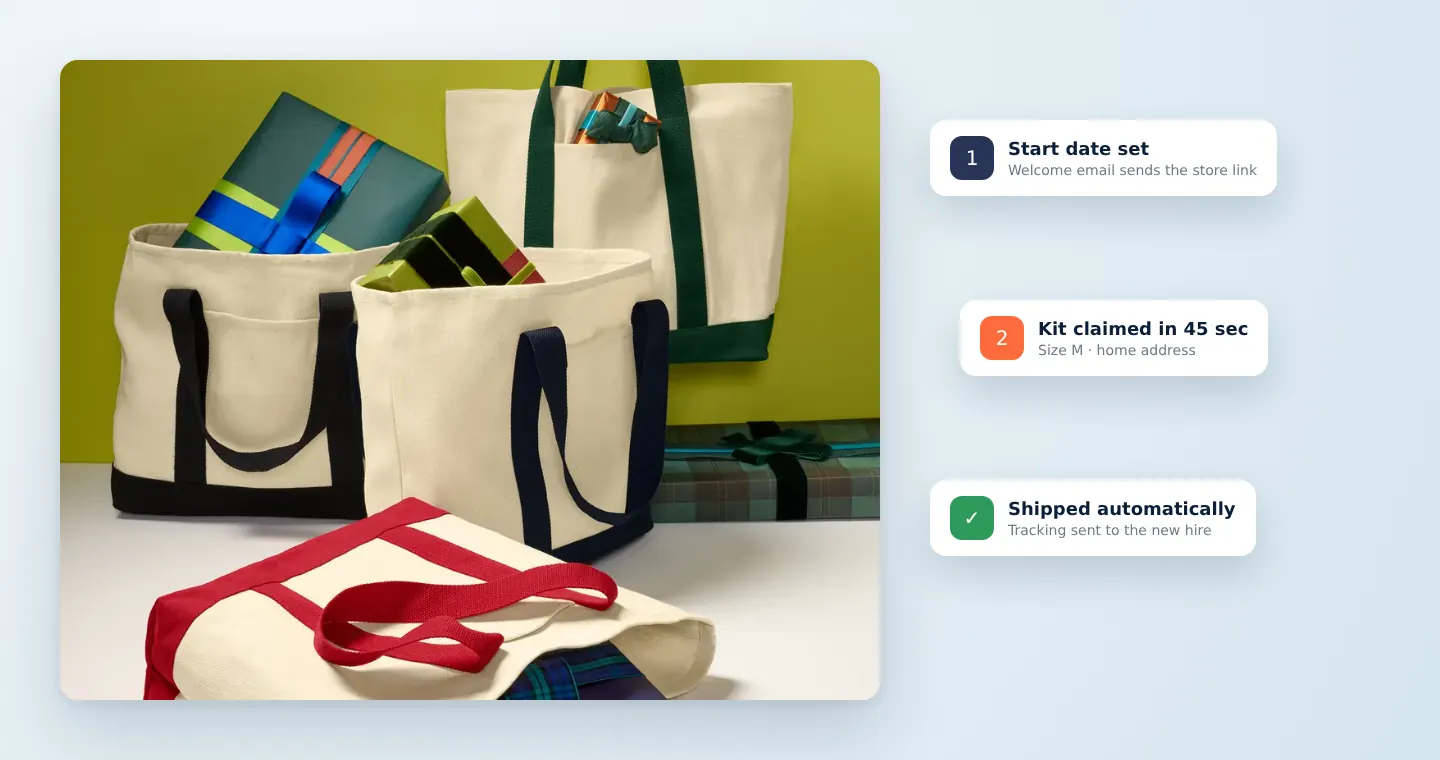
Most onboarding swag programs run in batches: collect a month of new hires, chase their sizes and addresses, place an order, ship. The result is a welcome kit that arrives weeks after day one, in the wrong size about one time in ten, after hours of spreadsheet work. A company store removes the batch entirely.
Why batching fails new hires
- Kits arrive after the moment they matter — the first week — has passed.
- Sizes are guessed or collected by email, so exchanges are common.
- Remote hires are easy to miss when a batch ships to the office.
- Someone in People Ops spends hours each month reconciling a spreadsheet.
The automated flow
| Step | Who does it | Time |
|---|---|---|
| Offer accepted or start date set | HR system or recruiter | Already happening |
| Welcome email includes the store link and a kit code | Automated template | 0 minutes |
| New hire picks sizes and enters their address | The new hire | Under a minute |
| Kit is packed and shipped with tracking | Merch partner | 0 minutes for you |
| Monthly report of kits shipped by team | Account manager | Read it |
You can try the employee side of this right now: our demo store lists a New Hire Joining Kit you can claim with a free test order.
What to put in an automated kit
Automation works best with a fixed, size-light kit plus one sized item:
- One sized apparel piece — a premium tee or hoodie — chosen at checkout.
- Unsized items: notebook, drinkware, laptop bag or tote, stickers.
- A printed welcome card from the team or a leader.
- Optional: a second sized item for roles that get uniforms or field gear.
For ideas on contents and budgets, see why great onboarding kits are the best ROI in employer branding.
Held stock makes it fast
Because a welcome kit is the same every time, it is the ideal item to hold in light inventory. The partner keeps a small buffer of kits and the most common sizes, so each order ships within days instead of waiting for a production run. Reorders are triggered by stock thresholds, not by someone remembering.
International and remote hires
Distributed teams are where automation pays off most, because nobody has to remember the hire who works three time zones away. Domestic delivery is straightforward; international destinations need a plan for duties and carriers — see our guide to onboarding international employees.
Getting started
Sterling Merch builds the store, holds kit stock, ships each kit as hires claim it, and reports monthly by team — with one dedicated account manager and no platform fee. Explore our corporate gift kits and company stores, or talk to us about automating your onboarding kits.